Phone or Bubble Level? Why Phone Sensors Now Work for RV Leveling
Camper, motorhome, caravan — everyone has their own way of getting level. A spirit level on the floor, a bubble on the dashboard, a dedicated gadget, or the phone that's already in your pocket. Here's why we built a leveling app around phone sensors, how accurate they really are today, and how to get the best reading out of yours.
Why Not Just Use a Bubble Level?
Fair question. A simple bubble level absolutely works — and for many people, it's all they need. It's cheap, it needs no battery and it never crashes.
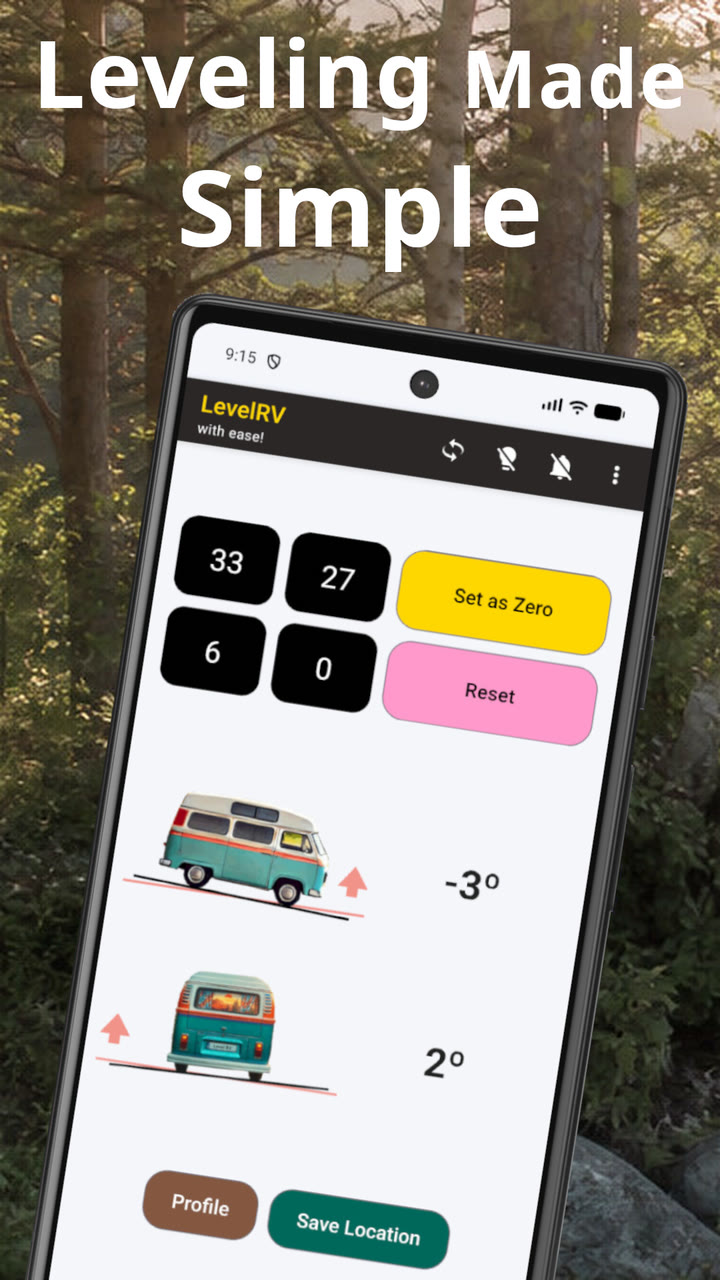
In our case, though, we wanted something visible from the driver's seat. Finding a perfectly flat spot on the dashboard that's also easy to see isn't always practical, and a bubble on the floor is invisible while you're driving onto the ramps. With an app on a phone holder, the first round of leveling happens without even stepping out of the vehicle.
A bubble also only tells you which way you're tilted, not how much. A phone shows the angle in degrees, works out how high each wheel has to go, and can call it out while you drive.
Bubble Level vs Phone App vs Dedicated Device
| Bubble level | Phone app | Dedicated device | |
|---|---|---|---|
| Cost | A few euros | Free — you already own the phone | Tens to hundreds of euros |
| Reading | Bubble position, no numbers | Degrees on both axes | Degrees or lift, depending on model |
| Lift per wheel | No — trial and error | Yes, from your track width and wheelbase | Often |
| From the driver's seat | Only if mounted where you can see it | Yes, in a phone holder — plus voice prompts | Usually, via a display or app |
| Typical accuracy | Good on a true surface | ~0.5–1° on modern phones | ~0.1–0.5° |
| Setup | None, but the surface must be level with the chassis | Calibrate once, then place it anywhere stable | Fixed installation |
How a Phone Measures Tilt
Every smartphone has an accelerometer: a tiny sensor that feels gravity. When the phone lies still, gravity pulls straight down, and the direction of that pull relative to the phone gives two angles — pitch (front to back) and roll (side to side). That's exactly what you need to level a vehicle.
A gyroscope measures rotation and helps smooth the reading while the vehicle is still moving or rocking. Combining the two — called sensor fusion — gives a steady value instead of a jittery one.
The biggest source of error isn't the sensor at all: it's where the phone sits. A dashboard, a holder or a shelf is rarely perfectly parallel to the chassis. That's why calibration matters: in Level RV you place the phone where you'll use it, park on known level ground and tap Set as zero. From then on, the app measures the vehicle, not the surface the phone happens to rest on.
How Reliable Are Phone-Based Sensors?
That was the main question we wanted to answer before building the app: how accurate can a leveling app based on smartphone sensors really be? The news turned out to be encouraging.
Phone makers have been steadily improving their sensors for years — mainly for photography, navigation and augmented reality. Tilt measurement (pitch and roll) has improved a lot as a side effect.
For comparison, dedicated RV leveling devices typically reach around 0.1–0.5°. A modern phone is now in the same league, especially once it's calibrated in its holder.
These are rough, simplified ranges for uncalibrated phones. Individual models vary, and calibration removes most of a phone's fixed offset.
| Phone era | Estimated tilt error |
|---|---|
| ~2010 | ~2–10° |
| ~2015 | ~0.5–3° |
| ~2020 | ~1.4–1.7° |
| ~2024+ | ~0.5–1° |
| Dedicated RV device | ~0.1–0.5° |
Is That Good Enough?
In our experience, anything below 1° is already perfectly fine for leveling a camper. You won't feel the difference in bed, the shower drains and the fridge is happy. You don't need lab-grade precision to get a good night's sleep.
And remember what you're correcting: on a typical 2 m wide vehicle, 1° is only about 3.5 cm of lift under one side. The ramp steps you drive onto are coarser than the phone's error.
More on targets and lift heights: How level is level enough?
Getting the Most Accurate Reading From Your Phone
- Calibrate in place. Zero the app with the phone exactly where you'll use it, on ground you know is level.
- Use a firm holder. A phone that wobbles or slides gives a wobbly reading. A dashboard mount or a fixed spot on a shelf is ideal.
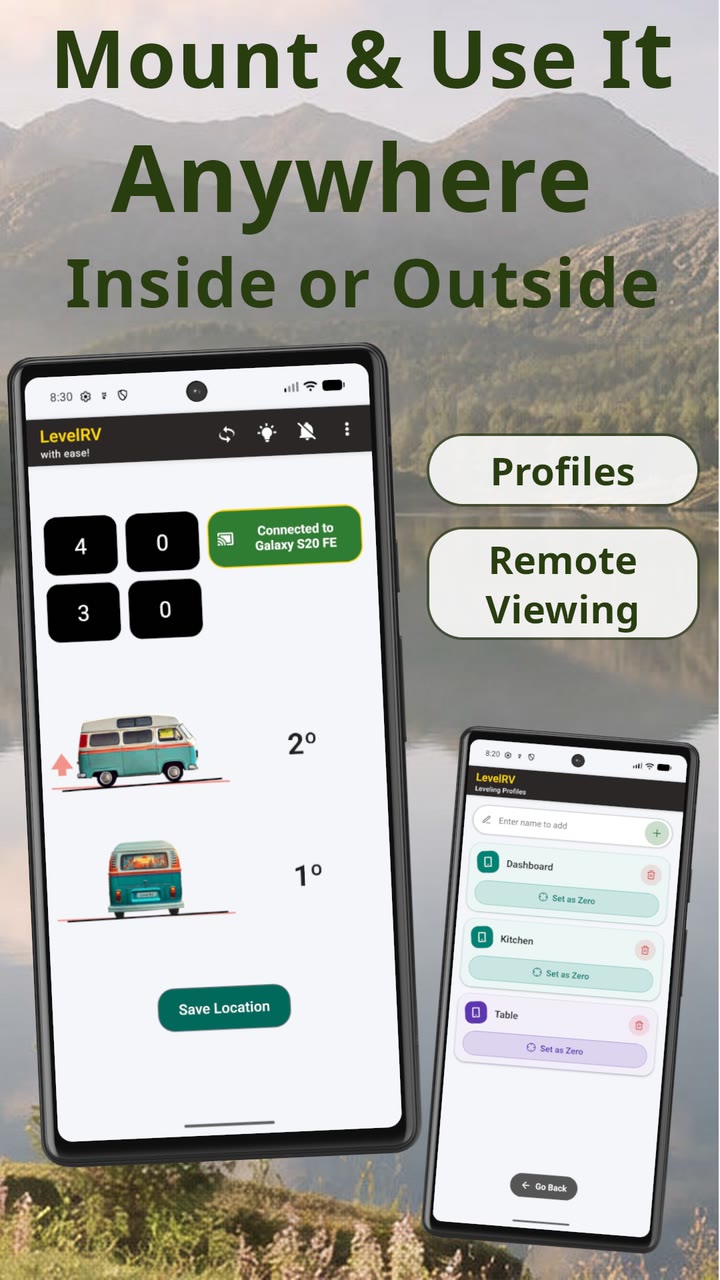
- Keep the same spot. Move the holder or change the case and the zero changes too — recalibrate, or save a profile for each position.
- Let it settle. Give the reading a second after the vehicle stops rocking.
- Engine off for the final check. Vibration is fine for rough leveling, but the fine correction is cleaner when everything is still.
- Use a second phone outside. With Level RV's Remote reading, the phone in the vehicle streams its level to the one in your hand at the wheel or jockey wheel.
Apps vs Dedicated Hardware
Modern leveling apps designed for camping have become surprisingly good. With sensor fusion, calibration and better hardware, they're now fast, convenient and accurate enough for real-world use.
Dedicated devices still make sense if you want a permanently installed unit that's always on, or you'd rather not use your phone at all. And they have one unbeatable advantage:
The joy of buying another cool gadget for your RV.
Quick Answers
Is a phone accurate enough to level an RV?
Yes. Recent phones measure tilt to roughly 0.5–1°, and calibrating the phone in its holder removes most of the remaining offset. Anything under 1° feels perfectly level in a camper.
Is a bubble level more accurate than a phone?
A good bubble level is precise, but only for the surface it sits on, and it doesn't give a number. A calibrated phone measures the vehicle itself, in degrees, and can work out the lift needed per wheel.
Do I need to calibrate a leveling app?
Yes, once for each place you put the phone. Calibration tells the app what "level" looks like in that exact position, so the phone doesn't need to lie on a flat surface.
Does a phone case affect the reading?
It can shift the angle slightly, which is fine as long as you calibrate with the case on and keep using the same case and holder.
Give Your Phone Another Chance
If you tried a leveling app a few years ago and were disappointed by the accuracy, it might be worth another shot. The device in your pocket has quietly become much more reliable. Happy — and level — camping!